RELIGIN AND SCIENCE

Selasa, Agustus 11, 2009

miracleofquran

The Miraculous Quran (part 10 of 11): Scientific Miracles


Description: A look at some of the scientific facts mentioned in the Quran which modern scientists, Muslim and non-Muslim alike, affirm as true.
By Jamaal al-Din Zarabozo (© 2007 IslamReligion.com)
Published on 16 Apr 2007 - Last modified on 01 Apr 2008
Viewed: 10021 (daily average: 12) - Rating: 3.8 out of 5 - Rated by: 4
Printed: 566 - Emailed: 5 - Commented on: 0

Category: Articles > Evidence Islam is Truth > The Authenticity and Preservation of the Holy Quran
Category: Articles > The Holy Quran > The Authenticity and Preservation of the Holy Quran

Scientific Miracles of the Quran

The “scientific miracles” of the Quran is a topic that many people are talking about nowadays, as the research in many fields continues. The source for this is probably the fact that there are literally hundreds of verses of the Quran in which God points to different aspects of this creation and encourages humans to reflect and learn from what they are seeing.

Shortly after I became Muslim, I became aware of Maurice Bucaille’s The Bible, the Quran and Science. For the sake of brevity, I wish to share with you the important conclusions that he reached:

The Quran follows on from the two Revelations that preceded it and is not only free from contradictions in its narrations, the sign of the various human manipulations to be found in the Gospels, but provides a quality all of its own for those who examine it objectively and in the light of science i.e. its complete agreement with modern scientific data. What is more, statements are to be found in it (as has been shown) that are connected with science: and yet it is unthinkable that a man of Muhammad's time could have been the author of them. Modern scientific knowledge therefore allows us to understand certain verses of the Quran which, until now, it has been impossible to interpret.

In view of the level of knowledge in Muhammad's day, it is inconceivable that many of the statements in the Quran which are connected with science could have been the work of a man. It is, moreover, perfectly legitimate, not only to regard the Quran as the expression of a Revelation, but also to award it a very special place, on account of the guarantee of authenticity it provides and the presence in it of scientific statements which, when studied today, appear as a challenge to explanation in human terms.[1]

In his discussion of the Quran, Bucaille emphasizes three important points:

a) First, there is nothing in the Quran that contradicts modern science;

b) second, there is no mention of some of the false beliefs that people had at that time of the Prophet Muhammad, may the mercy and blessings of God be upon him, concerning the creation, the universe and science in general; and,

c) three, there is no way that the Prophet Muhammad could have known at his time many of the facts alluded to in the Quran.

For the sake of brevity, though, it will be possible to discuss only one verse in some detail here demonstrating the “scientific miracles” of the Quran.[2]

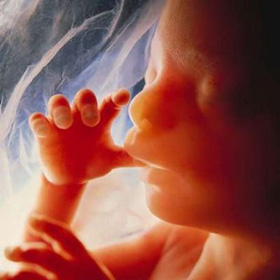
Upon reading the Quran, one topic that catches many a reader’s eye is the discussion of the creation of the human within the womb of the mother. God says in the Quran:

“We created man from an extract of clay. Then We made him as a drop in a place of settlement, firmly fixed. Then We made the drop into an alaqah (leech, suspended thing, and blood clot), then We made the alaqah into mudghah (chewed-like substance)…” (Quran 23:12-14)

This brief passage is outstanding in its precise description of the actual process as well as its freedom from all of the incorrect theories and views that were prevalent at the time of Muhammad. As noted in the translation, the Arabic word alaqah can imply leech, suspended thing or blood clot. In reality, all of these terms are descriptive of the embryo. In fact, in its earliest stage, the embryo not only actually physically looks like a leech[3] but it “obtains nourishment from the blood of the mother, similar to the leech, which feeds on the blood of others.”[4] Alaqah, again, can also mean, “suspended thing,” which is also true of the embryo in this stage as it sits hanging in the womb of the mother.[5] Finally, alaqah can also mean blood clot. Again, the relationship to the actual physical process is miraculous. Ibrahim writes:

We find that the external appearance of the embryo and its sacs during the alaqah stage is similar to that of a blood clot. This is due to the presence of relatively large amounts of blood present in the embryo during this stage… Also, during this stage, the blood in the embryo does not circulate until the end of the third week. Thus, the embryo as this stage is like a blood clot.[6]

The verse states that the next stage is that of a mudghah or “chewed-like substance.” This is also an amazingly accurate description of the next embryonic stage. At this stage, the embryo develops somites at its back and these “somewhat resemble teeth marks in a chewed substance.”[7]

The kind of information described above has only been “discovered” and seen by humans since the development of powerful microscopes. Ibrahim notes that Hamm and Leeuwenhoek were the first to observe human sperm cells, in 1677 due to the help of an improved microscope.[8] This took place some 1000 years after the time of the Prophet Muhammad, may the mercy and blessings of God be upon him.

In fact, the details and the analysis of the Quranic verses related to embryology are so great that Keith Moore, Professor Emeritus of Anatomy and Cell Biology at the University of Toronto, has included them in a special edition of his textbook The Developing Human: Clinically Oriented Embryology.[9] This is an interesting work that is comprised of Moore’s complete textbook with insertions describing some of the same topics from the point of view of the Quran and the sayings of the Prophet. After discussing advanced topics in embryology—most of which are the result of research in the past few decades—this textbook would then have pages inserted describing what the Quran has stated concerning the same issues. Can you imagine taking the best medical book from even just 200 years ago and doing something of this nature? It would be absurd and ludicrous as the material of the old textbook would be completely irrelevant. However, they could do this with the Quran, a book that does not even claim to be a medical textbook. Of course, it has a much stronger claim: it claims it is from God.

Commenting on the miraculous consistency between statements in the Quran and the historical development of Embryology, Dr. Moore stated in 1981, “It has been a great pleasure for me to help clarify statements in the Quran about human development. It is clear to me that these statements must have come to Muhammad from God, because almost all of this knowledge was not discovered until many centuries later. This proves to me that Muhammad must have been a messenger of God.”[10]

In fact, the Quran touches upon many sciences other than embryology, such as astronomy, physics, geography, geology, oceanography, biology, botany, zoology, medicine and physiology.[11] Thus, numerous other scientists from various fields have made similar conclusions concerning the Quran.[12]

How could it be that this illiterate man of some fourteen hundred years ago, the Prophet Muhammad, produced a book of this nature having so many scientific facts and details with perfect accuracy in it? Could it have been the case that this was all a coincidence and that the Prophet was an imposter? At least in my opinion, the answers to questions like these were very clear. Indeed, the claim that the Quran is not a revelation from God becomes more and more difficult to hold once one learns more about the Quran itself.

Incidentally, there are other historically related miraculous aspects of the Quran. For example, as opposed to the Bible, the Quran refers to the ruler at the time of Joseph as a “king” and never refers to him as a Pharaoh, although that term is used in the Bible in the story of Joseph, and the Quran uses that term in the story of Moses. It seems, from the best of what can be determined now, that Joseph lived among the Semitic Hyksos kings of Egypt and that his ruler was indeed not a Pharaoh.[13] The Quran also makes it clear that the body of the Pharaoh of the Exodus would be recovered and preserved.[14] Now, it is considered that all of the Pharaohs of that time have actually been preserved as mummies, something the Prophet also could not have known at that time. This has led two researchers to state:

If the Holy Quran was derived from the Bible [as some people falsely claim, then] those many Biblical errors would have passed into it. Why, for instance, would the Holy Quran describe the Israelites as a small nation when the Bible claims that they were 2-3 million, an enormously inflated number that no scholar would accept?... Why did the Holy Quran not go along the Biblical, and indeed logical belief that Pharaoh was swallowed by the sea, to state instead that Pharaoh’s “body” was rescued? And why would the Holy Quran say this about Pharaoh in particular but not about other people who were also destroyed by God?...[15]

Finally, Muslim scholars have noted that the particular miracle given to each prophet was related to issues that their people were most fascinated with. Thus, for example, during the time of Moses, sorcery was very popular, and one of his signs was directly related to outdoing the weak tricks of humans. During Jesus time, medicine was a popular issue and some of Jesus’ signs included healing the sick, raising the dead and so on. The Arabs at the time were very proud of their literary skills and, as shall be noted shortly, the Quran is an Arabic masterpiece beyond what they could match. However, the Prophet Muhammad was not sent only to the Arabs or only to the people of his century. In this day and age, science has practically become a “god” to replace the traditional God of the Judeo-Christian tradition. The Prophet Muhammad’s miracle is actually completely relevant to the field of science that captivates so many people today, once again indicating that the Prophet Muhammad was truly a prophet for all of humanity until the Day of Judgment.


Footnotes:

[1] Maurice Bucaille, The Bible, the Quran and Science (Indianapolis, IN: American Trust Publications, 1978), pp. 251-252.

[2] For more details concerning the different stages of human development, the interested reader may also consult Keith L. Moore, Abdul-Majeed A. Zindani and Mustafa A. Ahmed, Quran and Modern Science: Correlation Studies (Bridgeview, IL: Islamic Academy for Scientific Research, 1990), pp. 15-47.

[3] See I. A. Ibrahim, p. 7, Figure 1.

[4] I. A. Ibrahim, p. 6.

[5] See I. A. Ibrahim, p. 7, Figure 2.

[6] Ibrahim, p. 8.

[7] Quoted by Ibrahim, p. 8, from Moore and Persaud, The Developing Human, 5th ed., p. 8. Also see Ibrahim’s figures on page 9.

[8] Ibrahim, pp. 8-10.

[9] See Keith L. Moore [along with Abdul-Majeed Azzindani], The Developing Human: Clinically Oriented Embryology [with Islamic Additions: Correlation Studies with Quran and Hadith] Jeddah, Saudi Arabia: Dar al-Qiblah for Islamic Literature, 1983, in conjunction with W. B. Saunders Company.

[10] Quoted in I. A. Ibrahim, A Brief Illustrated Guide to Understanding Islam (Houston: Darussalam, 1997), p. 10.

[11] For examples concerning these different fields, see Zakir Naik, “The Quran and Modern Science: Compatible or Incompatible?” www.ahya.org.

[12] See I. A. Ibrahim, A Brief Illustrated Guide to Understanding Islam (Houston: Darussalam, 1997), pp. 10ff. This work, in its entirety, is available at www.islam-guide.com. Ibrahim reviews and summarizes the conclusions of Moore and a number of others.

[13] For more details on this point, see Louay Fatoohi and Shetha al-Dargazelli, History Testifies to the Infallibility of the Quran: Early History of the Children of Israel (Delhi, India: Adam Publishers & Distributors, 1999), pp. 81-93.

[14] God says, “So this day We shall deliver your (dead) body (out from the sea) that you may be a sign to those who come after you! And verily, many among mankind are heedless of signs” (Yoonus 10:92). For more on this point, see Fatoohi and al-Dargazelli, pp. 141-145.

[15] Fatoohi and al-Dargazelli, pp. 247-248.

ARMADA

Senin, Agustus 10, 2009

god'sfinalrevelation

The Story of the Quran (part 1 of 2): God’s Final Revelation

In the top 20 of viewed articles A new article (Published within the last 30 days)
Description: What is the Quran?
By Aisha Stacey (© 2009 IslamReligion.com)
Published on 03 Aug 2009 - Last modified on 10 Aug 2009
Viewed: 611 (daily average: 75) - Rating: 5 out of 5 - Rated by: 3
Printed: 19 - Emailed: 2 - Commented on: 0

Category: Articles > The Holy Quran > The Authenticity and Preservation of the Holy Quran

Muslims believe the Quran to be God’s final revelation. They believe it is the literal word of God, revealed over many years, to His final prophet, Muhammad. The Quran is full of wisdom. It is full of the wonder and glory of God, and a testament to His mercy and justice. It is not a history book, a storybook, or a scientific textbook, although it contains all of those genres. The Quran is God's greatest gift to humanity – it is a book like no other. In the second verse of the second chapter of the Quran, God describes the Quran by calling it a book whereof there is no doubt, a guidance to those who are pious, righteous, and fear God. (Quran 2:2)

The Quran is core to Islam. Believing in it is a requirement. One who does not believe in the Quran, in its entirety, cannot claim to be a Muslim.

"The Messenger (Muhammad) believes in what has been sent down to him from his Lord, and (so do) the believers. Each one believes in God, His Angels, His Books, and His Messengers. (They say,) ‘We make no distinction between one another of His Messengers’ — and they say, ‘We hear, and we obey. (We seek) Your forgiveness, our Lord, and to You is the return (of all)’." (Quran 2:285)

Islam has two primary sources, the Quran, and the authentic traditions of Prophet Muhammad, that explain and sometimes expand on that of the Quran.

“And We have not sent down the Book (the Quran) to you (O Muhammad, except that you may explain clearly unto them those things in which they differ, and (as) a guidance and a mercy for a folk who believe.” (Quran 16:64)

The Quran was delivered to Prophet Muhammad by the Angel Gabriel and revealed in stages over a period of 23 years.

“And (it is) a Quran which We have divided into parts, in order that you might recite it to men at intervals. And We have revealed it by stages.” (Quran 17:106)

Prophet Muhammad was commanded by God to convey the Quran to all of humankind and the responsibility weighed heavily upon him. Even in his farewell address he called on the people present to bear witness that he had delivered the message.

The Quran explains the concept of God, it explains in detail what is permissible and what is forbidden, it explains the basics of good manners and morals, and gives rulings about worship. It tells stories about the Prophets and our righteous predecessors, and describes paradise and hell. The Quran is a guidance, a mercy and a book of glad tidings for those who have submitted themselves to God. (Quran 16:89) The Quran was revealed for all of humankind.

The book in which the Quran (the words of God) are contained in is called a mus haf. The Quran is considered so unique in content and style that it cannot be precisely translated; therefore, any translation is considered an interpretation of the meanings of Quran.

When God sent Prophets to the various nations He often allowed them to perform miracles that were relevant to their particular time and place. In the time of Moses magic and sorcery were prevalent therefore Moses’ miracles appealed to the people he was sent to guide. In the time of Muhammad, the Arabs, although predominantly illiterate, were masters of the spoken word. Their poetry and prose was considered outstanding and a model of literary excellence.

When Prophet Muhammad recited the Quran – the words of God – the Arabs were moved tremendously by its sublime tone and extraordinary beauty. The Quran was Prophet Muhammad’s miracle from God. Muhammad was unable to read or write therefore the Arabs knew that he was unlikely to have produced such eloquent words, but even so some refused to believe that the Quran was the word of God. God therefore challenged them, in the Quran, to produce a rival text.

“And if you (Arab pagans, Jews, and Christians) are in doubt concerning that which We have sent down (i.e. the Quran) to Our slave (Muhammad), then produce a chapter of the like thereof and call your witnesses (supporters and helpers) besides God, if you are truthful.” (Quran 2:23)

Of course they were unable to do so. In contrast to those who questioned the origin of the Quran, many Arabs converted to Islam after hearing the recitation. They knew immediately that such sublime beauty could originate only from God. Even today it is possible to see Muslims moved to tears while listening to or reciting the Quran. In fact some people, unable to understand even one word of the Arabic language are moved by the intrinsic beauty of the Quran.

After establishing that Quran is the word of God and that it is a recitation, it is also important to understand that Quran has remained unchanged for more than 1400 years. Today when a Muslim in Egypt holds his mus haf in his hands and begins to recite you can be sure that in far away Fiji another Muslim is looking at and reciting the exact same words. There are no differences. The child in France holding his first mus haf is tentatively reciting the same words that flowed from the lips of Prophet Muhammad.

God assures us in Quran that He will surely protect His words. He says, “Verily, it is We Who have sent down the Quran and surely, We will guard it (from corruption).” (Quran 15:9) This means that God will guard against anything false being added or any part of it being taken away.[1] It is protected from tampering and if anyone attempts to distort the meanings of Quran, God will guide someone to expose the deception.[2] Muslims believe that the previous revelations from God, including the Torah and the Gospels of Jesus were either lost in antiquity, or changed and distorted, so it is a source of comfort to them knowing that God’s words – the Quran – are now well guarded.

God sent down Quran, from above the heavens, to the angel Gabriel in the glorious month of Ramadan. The story of how this recitation was revealed and how Quran came to be available worldwide, with an interpretation of the meanings translated into over 100 languages[3] will be covered in part 2.

ARMADA

storyquran

The Story of the Quran (part 2 of 2): From the Preserved Tablet to ഹുമാങ്കിന്ദ്

“And thus, We have sent to you O Muhammad a revelation, and a mercy of Our Command. You knew not what the Book is, nor what is Faith? But We have made it (this Quran) a light wherewith We guide whosoever of Our slaves We will. And verily, you O Muhammad are indeed guiding (humankind) to the Straight Path.” (Quran 42:52)

Prophet Muhammad, the man Muslims believe to be the final messenger from God, received the revelation - the Quran, in two stages. These perfect words of God were sent down to guide humankind out of the darkness and into the light; they are guidance and a mercy. The Quran – the words of God are perfect words, from a perfect God, to His Creation. On the night known as the night of power, in the Islamic month of Ramadan, the Quran descended, from the preserved tablet[1] to the lowest heaven. It then descended from the heavens to the earth in small stages.

The revelation was delivered to Prophet Muhammad through the angel Gabriel.[2] When Prophet Muhammad was around forty years of age he started to spend time in deep reflection. According to his beloved wife Aisha[3] the love of seclusion was bestowed upon him via vivid good dreams. He would go to the cave known as Hira to worship the One God and contemplate life, the universe, and his place in the world.

One night during Ramadan an angel came to him and asked him to read. The Prophet, who was unable to neither read nor write, replied 'I do not know how to read'. The angel then held him forcibly and pressed his chest so hard that he could not bear the pressure. The angel then released Muhammad and asked him once more to read. Again he replied “but I do not know how to read”. The angel held him forcibly three times and Muhammad responded each time that he did not know how to read (or asked what shall I read). The angel then revealed the first words of Quran.[4]

“Read! In the Name of your Lord, Who has created (all that exists), Has created man from a clot (a piece of thick coagulated blood). Read! And your Lord is the Most Generous, Who has taught by the pen, Has taught man that which he knew not.” (Quran 96:1-5)

After this first revelation, which Muhammad found frightening, he was not visited by the angel Gabriel again for an undetermined amount of time. The next time he encountered him (the angel) he was walking alone. Prophet Muhammad heard a voice from the heavens. When he looked up he saw the angel sitting on a chair between the sky and the earth. Muhammad was afraid and ran home seeking comfort and asking to be wrapped in blankets. The second revelation occurred at this time.[5]

“O you covered in garments arise and warn the people of a severe punishment...” (Quran 74:1-5)

Over the next 23 years until shortly before Prophet Muhammad’s death, the Quran was revealed in stages. Several reasons have been suggested for this. Some say that it was revealed slowly to offer Prophet Muhammad support and address issues as they arose. The entire experience was difficult for Prophet Muhammad therefore a slow process allowed him time to recover from each bout of revelation.

Aisha, the wife of the Prophet narrates that when asked about how the divine inspiration was revealed Prophet Muhammad replied, “Sometimes it is like the ringing of a bell, this form of inspiration is the hardest of all and then this state passes after I have grasped what is inspired. Sometimes the Angel comes in the form of a man and talks to me and I grasp whatever he says”.[6] Ibn Abbas described Prophet Muhammad as bearing the revelation “with great trouble and moving his lips quickly”.[7]As the words of Quran were revealed to Prophet Muhammad he began to commitment them to memory.

Memorisation was considered important and was widely practised even in the early years of Islam. Prophet Muhammad requested that his companions memorise Quran and used various measures to assure that the revelation was preserved in their memories. According to Ibn Hisham, author of one of the first biographies of Prophet Muhammad, Abdullah Ibn Masood was the first man, after Muhammad, to recite the Quran publicly and on this occasion was severely beaten about the face. Prophet Muhammad’s closest companion Abu Bakr was also known to recite Quran outside his home in Mecca.[8]

Quran was memorised by the companions during Prophet Muhammad’s lifetime and this tradition has continued through the following generations. Even today Muslims unable to read Arabic memorise the exact same words that were memorised by the Arabs of the 7th century CE. The majority of the Arabs were illiterate, including Prophet Muhammad; however the importance of the written word was well understood.

Preserving the divine revelation was paramount; therefore trustworthy and knowledgeable people memorised and wrote down the words of Quran. These included the four men destined to follow Muhammad as leaders of the Muslim nation and a man named Zaid Ibn Thabit, who would be instrumental in the preservation of Quran for the many generations to follow.

Writing materials were difficult to obtain and in these very early days portions of Quran were written onto animal skins, thin light coloured stones, bones, and even bark. The companions would write down the words of revelation and Prophet Muhammad would listen to the men recite from the written word to make sure there were no mistakes. It could be said that the Quran was written down under the direct supervision of Prophet Muhammad. The Quran was not revealed in order, however the angel Gabriel instructed Prophet Muhammad on how to compile the Quran in the divinely inspired correct sequence.


Footnotes:

[1] Lauh Al-Mahfuz (the preserved tablet) is the book in which God wrote the divine decrees and the destiny of all of creation. It was with God before the creation.

[2] Suyuti’ in Al Itqan Fi Ulum Al Quran, Beirut, 1973, Vol. I pp. 39-40 based on three reports from 'Abdullah Ibn 'Abbas, in Hakim, Baihaqi and Nasa'i.

[3] Saheeh Al-Bukhari

[4] These are the first words that were revealed, not to be confused with the first chapter of Quran, for Quran chapters were not revealed in order.

[5] Saheeh Al-Bukhari

[6] Ibid

[7] Ibid

[8] Ibn ഹിഷാം

By Aisha Stacey

പവര്‍ ഓഫ് ISLAM

ഇസ്ലാം ഈസ്‌ POWER

The word “Muslim” means one who submits to the will of God, regardless of their race, nationality or ethnic background. Becoming a Muslim is a simple and easy process that requires no pre-requisites. One may convert alone in privacy, or he/she may do so in the presence of others.

If anyone has a real desire to be a Muslim and has full conviction and strong belief that Islam is the true religion of God, then, all one needs to do is pronounce the “Shahada”, the testimony of faith, without further delay. The “Shahada” is the first and most important of the five pillars of Islam.

With the pronunciation of this testimony, or “Shahada”, with sincere belief and conviction, one enters the fold of Islam.

Upon entering the fold of Islam purely for the Pleasure of God, all of one’s previous sins are forgiven, and one starts a new life of piety and righteousness. The Prophet said to a person who had placed the condition upon the Prophet in accepting Islam that God would forgive his sins:

“Do you not know that accepting Islam destroys all sins which come before it?” (Saheeh Muslim)

When one accepts Islam, they in essence repent from the ways and beliefs of their previous life. One need not be overburdened by sins committed before their acceptance. The person’s record is clean, and it is as if he was just born from his mother’s womb. One should try as much as possible to keep his records clean and strive to do as many good deeds as possible.

The Holy Quran and Hadeeth (prophetic sayings) both stress the importance of following Islam. God states:

“...The only religion in the sight of God is Islam...” (Quran 3:19)

In another verse of the Holy Quran, God states:

“If anyone desires a religion other than Islam, never will it be accepted of him; and in the Hereafter, he will be in the ranks of those who have lost (their selves in the Hellfire).” (Quran 3:85)

In another saying, Muhammad, the Prophet of God, said:

“Whoever testifies that there in none worthy of being worshipped but God, Who has no partner, and that Muhammad is His slave and Prophet, and that Jesus is the Slave of God, His Prophet, and His word[1] which He bestowed in Mary and a spirit created from Him; and that Paradise (Heaven) is true, and that the Hellfire is true, God will eventually admit him into Paradise, according to his deeds.” (Saheeh Al-Bukhari)

The Prophet of God, may the blessing and mercy of God be upon him, also reported:

“Indeed God has forbidden to reside eternally in Hell the person who says: “I testify that none has the right to worship except Allah (God),’ seeking thereby the Face of God.” (Saheeh Al-Bukhari)

The Declaration of the Testimony (Shahada)

To convert to Islam and become a Muslim a person needs to pronounce the below testimony with conviction and understanding its meaning:

I testify “La ilah illa Allah, Muhammad rasoolu Allah.”

The translation of which is:

“I testify that there is no true god (deity) but God (Allah), and that Muhammad is a Messenger (Prophet) of God.”

To hear it click here or click on “Live Help” above for assistance by chat.

When someone pronounces the testimony with conviction, then he/she has become a Muslim. It can be done alone, but it is much better to be done with an adviser through the “Live Help” at top, so we may help you in pronouncing it right and to provide you with important resources for new Muslims.

The first part of the testimony consists of the most important truth that God revealed to mankind: that there is nothing divine or worthy of being worshipped except for Almighty God. God states in the Holy Quran:

“We did not send the Messenger before you without revealing to him: ‘none has the right to be worshipped except I, therefore worship Me.’” (Quran 21:25)

This conveys that all forms of worship, whether it be praying, fasting, invoking, seeking refuge in, and offering an animal as sacrifice, must be directed to God and to God alone. Directing any form of worship to other than God (whether it be an angel, a messenger, Jesus, Muhammad, a saint, an idol, the sun, the moon, a tree) is seen as a contradiction to the fundamental message of Islam, and it is an unforgivable sin unless it is repented from before one dies. All forms of worship must be directed to God only.

Worship means the performance of deeds and sayings that please God, things which He commanded or encouraged to be performed, either by direct textual proof or by analogy. Thus, worship is not restricted to the implementation of the five pillars of Islam, but also includes every aspect of life. Providing food for one’s family, and saying something pleasant to cheer a person up are also considered acts of worship, if such is done with the intention of pleasing God. This means that, to be accepted, all acts of worship must be carried out sincerely for the Sake of God alone.

The second part of the testimony means that Prophet Muhammad is the servant and chosen messenger of God. This implies that one obeys and follows the commands of the Prophet. One must believe in what he has said, practice his teachings and avoid what he has forbidden. One must therefore worship God only according to his teaching alone, for all the teachings of the Prophet were in fact revelations and inspirations conveyed to him by God.

One must try to mold their lives and character and emulate the Prophet, as he was a living example for humans to follow. God says:

“And indeed you are upon a high standard of moral character.” (Quran 68:4)

God also said:

“And in deed you have a good and upright example in the Messenger of God, for those who hope in the meeting of God and the Hereafter, and mentions God much.” (Quran 33:21)

He was sent in order to practically implement the Quran, in his saying, deeds, legislation as well as all other facets of life. Aisha, the wife of the Prophet, when asked about the character of the Prophet, replied:

“His character was that of the Quran.” (As-Suyooti)

To truly adhere to the second part of the Shahada is to follow his example in all walks of life. God says:

“Say (O Muhammad to mankind): ‘If you (really) love God, then follow me.’” (Quran 3:31)

It also means that Muhammad is the Final Prophet and Messenger of God, and that no (true) Prophet can come after him.

“Muhammad is not the father of any man among you but he is the Messenger of God and the last (end) of the Prophets and God is Ever All-Aware of everything.” (Quran 33:40)

All who claim to be prophets or receive revelation after Muhammad are imposters, and to acknowledge them would be tantamount to disbelief.

We welcome you to Islam, congratulate you for your decision, and will try to help you in any way we can.

Kamis, Januari 29, 2009

EVIDENCE Of TRUTH OF AL QURAN

EVIDENCE Of TRUTH OF AL QURAN

Posted by : A.ARMADA PAHLA, M.Pd


"Religion can become a success guide for the seeking of science. And Islam can reach success in this case. There is not oposition among science of genetika and religion. this reality in al-Quran posed at by science become validly. AI-QURAN coming from Allah support science "

Prof. Dr. Joe Leigh Simpson
Chief Majors Gynecology and Gynaecology and Prof. Molecular and of Genetika Human Being Baylor College Medicine, Houston United States


" Prophet of Muhammad SAW as science book of Allah "

Prof. Marshall Johnson

Professor Science Anatomy and Growth Of Biology

University of Thomas Jefferson

Philadelphia, Pennsylvania United States


"AI-QURAN is a book, guide, truth, evidence and endless truth for us to the last epoch"

Prof. TVN Persaud

Expert Anatomy, children hygienist,

and midwifery gynaecologist and reproduction science

in University of Manitoba, Winnipeg, Menitoba Canadian


" that all is written in al-Quran sure a truth, demonstrably with erudite equipments"

Prof. Tejatat Tejasen

Chief Majors Anatomy University of Thailand Chiang Mai


"... modern erudite method now prove what have been told last Muhammad 1400 year. AI-QURAN is science textbook which is simpel and modestly to one who modestly "

Prof. Alfred Kroner

Chief Majors Geology Institute of Geosciences

University of Johannnes Gutterburg, Maintz Germany


"AI-QURAN is book amazing depicting past, now, and future"

Prof. Palmer

Expert Geology distinguish for United States


" that man of science in fact only affirming what have been written in last some years alQuran. All man of science now only finding what having in al-Quran since last 1400 year"

Prof. Shroeder

Man of science Oceaninc of Germany


" By reading al Quran, I earn to find my future road street to the investigation of universe "

Prof. Yoshihide Kozai

Professor University of Tokyo and Director of The National Astronomical Observatory, Mikata, Tokyo Japan

Rabu, Januari 28, 2009

SCIENCE IN QUR'AN

INDEX OF QUR'AN

Posted by A. Armada Pahla, M.Pd

1. Creation Of Arsy

LQ.7:54
LQ.13:2
LQ.25:59


2. Chair Allah ( Power And His Science)

LQ.2:255


3. Creation Of Lauhhil Mahfuzh

LQ.13:39
LQ.17:58
LQ.20:52
LQ.85:22


4. Creation of earth and sky

LQ.2:22
LQ.2:29
LQ.2:164
LQ.6:1
LQ.6:14
LQ.6:73
LQ.6:79
LQ.6:101
LQ.7:54
LQ.10:3
LQ.11:7
LQ.13:2
LQ.14:10
LQ.14:19
LQ.15:19
LQ.15:85
LQ.16:3
LQ.17:99
LQ.18:51
LQ.20:4
LQ.21:16
LQ.25:59
LQ.27:60
LQ.29:44
LQ.29:61
LQ.40:57
LQ.50:38
LQ.41:9
LQ.41:11
LQ.44:38
LQ.44:39
LQ.45:22
LQ.46:33
LQ.50:6
LQ.50:7
LQ.78:6
LQ.51:7
LQ.51:47
LQ.51:48
LQ.52:36
LQ.55:7
LQ.55:10
LQ.57:4
LQ.71:15
LQ.78:6
LQ.78:12
LQ.79:27
LQ.79:28
LQ.88:18
LQ.88:20
LQ.91:5
LQ.91:6

5. Creation of mount

LQ.13:3
LQ.16:15
LQ.77:27
LQ.78:7
LQ.79:32
LQ.88:19


6. Creation of river and sea

LQ.13:3
LQ.16:14
LQ.16:15
LQ.25:53
LQ.27:61
LQ.45:12
LQ.55:22


7. Creation of animal

LQ.2:164
LQ.2:259
LQ.3:14
LQ.16:5
LQ.22:18
LQ.24:45
LQ.35:28
LQ.40:79
LQ.42:11
LQ.42:29
LQ.43:12
LQ.47:12


8. Creation of insect

LQ.16:68
LQ.22:73
LQ.34:14


9. Creation of creature which is life in water

LQ.16:14
LQ.18:61
LQ.18:63


10. Creation of animal slither

LQ.20:20
LQ.24:45


11. Creation of flora

LQ.2:261
LQ.6:99
LQ.6:141
LQ.13:4
LQ.16:11
LQ.16:67
LQ.17:91
LQ.18:32
LQ.34:16
LQ.50:10
LQ.55:11
LQ.55:12
LQ.86:12
LQ.95:1


12. Creation of countrys

LQ.3:96
LQ.3:97
LQ.14:35
LQ.27:91
LQ.28:57
LQ.29:67
LQ.90:1
LQ.95:3
LQ.17:1
LQ.21:71
LQ.21:81
LQ.10:87
LQ.12:21
LQ.12:99
LQ.43:51


13. Sentences about star

LQ.6:97
LQ.7:54
LQ.16:12
LQ.16:16
LQ.81:15
LQ.81:16
LQ.86:1
LQ.86:2
LQ.86:3


14. Sentences about wind

LQ.2:164
LQ.34:12
LQ.45:5
LQ.51:1
LQ.51:41
LQ.51:42
LQ.77:1
LQ.77:2


15. Creation of month;moon and sun

LQ.7:54
LQ.16:12
LQ.21:33
LQ.36:39
LQ.91:1
LQ.91:2


16. Nature of month;moon and sun

LQ.6:96
LQ.10:5
LQ.13:2
LQ.14:33
LQ.16:12
LQ.78:13


17. Sentences about rain and cloud

LQ.2:19
LQ.2:20
LQ.2:164
LQ.7:57
LQ.13:12
LQ.24:43
LQ.43:11
LQ.51:2
LQ.78:14


18. Creation of noon and night

LQ.2:164
LQ.3:27
LQ.6:1
LQ.6:96
LQ.7:54
LQ.13:3
LQ.16:12
LQ.17:12
LQ.21:33
LQ.24:44
LQ.27:86
LQ.28:71
LQ.28:72
LQ.28:73
LQ.36:37
LQ.78:10
LQ.79:29
LQ.81:17
LQ.81:18
LQ.89:4
LQ.91:3
LQ.91:4